
Assessing grey belt in accordance with the new NPPF
It is now approaching two years since the grey belt concept was formally introduced into planning policy via the December 2024 version of the National Planning Policy Framework ('the Framework'). The approach to grey belt was clarified by subsequent updates to the National Planning Practice Guidance (‘the PPG’), published in February 2025.
The keenly anticipated release of the Framework in August 2026 improves clarity and has the effect of embedding a series of codified policies to create a clearer and more structured framework with which to assess development.
The policies pertaining to Green Belt are set out in Chapter 13 of the Framework in Policies GB1 to GB8. These include some subtle updates to the policies that are pertinent to the interpretation of grey belt.
This article provides a brief overview of the stepped process that underpins any assessment of prospective grey belt sites in accordance with the Framework.
Step 1: Purposes of Green Belt
In assessing whether a site may be categorised as grey belt, the logical starting point is to understand the five purposes of the Green Belt which are set out in Policy GB2 of the Framework:
a) Check the unrestricted sprawl of large built-up areas;
b) Prevent neighbouring towns merging into one another;
c) Assist in safeguarding the countryside from encroachment;
d) Preserve the setting and special character of historic towns; and
e) Assist urban regeneration by encouraging the recycling of derelict and other urban land.
Three of the purposes are relevant as part of the first step in determining whether a site comprises grey belt land. The definition of grey belt is provided in Annex B as follows:
“Grey belt: For the purposes of plan-making and decision-making, grey belt is defined as land in the Green Belt comprising previously developed land and/or any other land that, in either case, does not strongly contribute to any of purposes (a), (b), or (d) in policy GB2.”
It is worth noting that the new definition of grey belt removes any reference to footnote 7, which was included in the definition of grey belt contained in the previous version of the NPPF. In this regard, the previous definition stated that grey belt excludes land where the application of the policies relating to the areas or assets in footnote 7 would provide a strong reason for refusing or restricting development. In other words, a site would not meet the test of grey belt if the decision-maker deemed that there was a ‘strong reason’ for refusing or restricting development due to its location on a designated site (SAC, SPA, SSSI and Ramsar), Local Green Space, National Landscape, National Park (or within the Broads Authority), Heritage Coast, or due to its impact on irreplaceable habitats, designated heritage assets (and other heritage assets of archaeological interest), and areas at risk of flooding or coastal change. The removal of footnote 7 from the new definition of grey belt could be considered as a liberalisation of the grey belt concept from other policy issues.
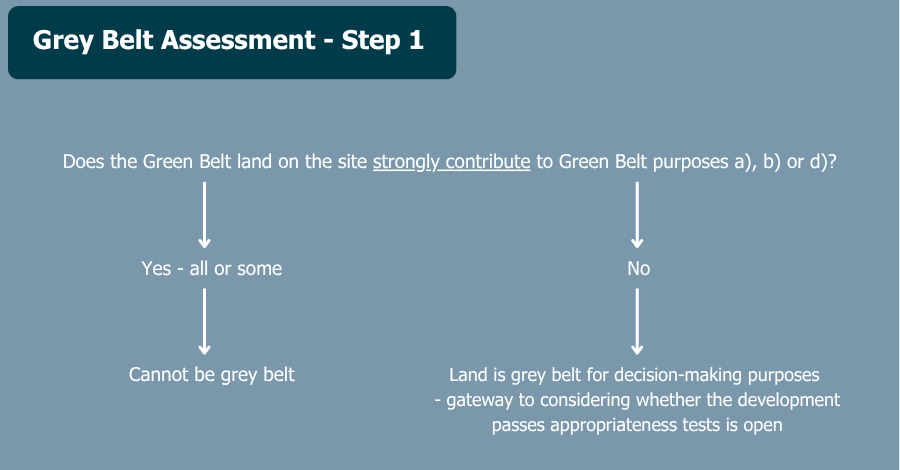
The first step in assessing whether a site meets the grey belt tests involves assessing whether the land in question ‘strongly’ contributes to purposes a), b) or d) of the Green Belt.
The Framework includes clear advice on how to assess the relative contribution a site makes to the Green Belt, which includes an overview of the illustrative features associated with land that makes a ‘strong’, ‘moderate’ or ‘weak’ contribution. This advice is outlined in Annex E of the new NPPF and reflects the guidance that was previously provided in the February 2025 updates to the PPG.
Step 2: Compliance with Policy GB7
If the site does not make a strong contribution to purposes a), b) and d) of the Green Belt, the next step is to assess the development proposal against the criteria set out in Policy GB7 of the NPPF.
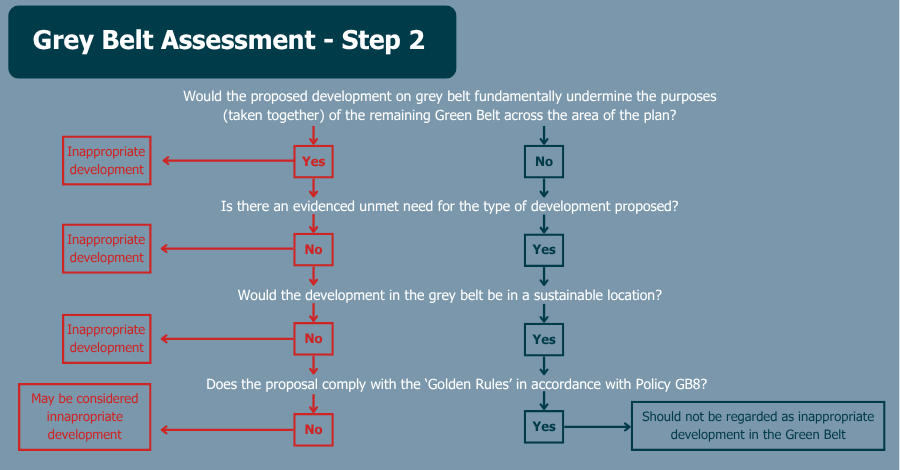
Policy GB7 consolidates into a single policy those forms of development which are not inappropriate in the Green Belt. Part (g) of Policy GB7 is relevant to the grey belt and effectively replaces Paragraph 155 of the previous Framework. Development will not be inappropriate where all of the following criteria apply:
i) The development would utilise grey belt land and would not fundamentally undermine the purposes (taken together) of the remaining Green Belt across the area of the plan;
ii) There is an evidenced unmet need for the type of development proposed;
iii) The development would be in a sustainable location, with particular reference to policy TR3 of this Framework;
iv) In the case of major development involving the provision of housing, the development proposed complies with policy GB8.
The policy wording includes a subtle shift in terminology with Policy GB7 requiring “an evidenced unmet need for the type of development proposed”. This differs to the wording in Paragraph 155 of the previous NPPF which referred to “a demonstrable unmet need for the type of development proposed”. Some legal practitioners have suggested that replacing the word “demonstrable” with “evidenced” might constitute a raising of the bar in terms of the supporting information to be provided in support of an application for a grey belt site. In practice, it remains to be seen whether the linguistic change will have a discernible impact on how decision-makers assess the grey belt. In practice, early decisions suggest that evidence of unmet need could be wider and allow this criterion to be satisfied by evidence of affordable housing need for example.
Rather than focusing on the change in wording, perhaps the more salient practical point for planning professionals is that the updated policy wording is a reminder that unmet need is a key requirement of the grey belt criteria and should not be assumed as a fait accompli. In this regard, an applicant for planning permission might be able to demonstrate that there is an unmet need for housing at a local level, thereby meaning that a site could be categorised as grey belt. However, the same applicant might not be able to demonstrate that there is an unmet need for an alternative use (such as commercial), which would effectively mean that the same site could not be categorised as grey belt for that alternative use. To this end, the need for any development proposal will be one factor that ultimately determines whether the proposal complies with Policy GB7, thereby allowing it to considered grey belt.
The Framework also elevates the importance of a sustainable location. This is a requirement that features, in different ways, in both Part g) and Part h) of Policy GB7. Reference to Policy TR3 brings in consideration of the new Connectivity Tool which offers a guide to the sustainability of the location and access to goods and services. The implication is clear, that sites that are accessible and well connected can be considered for grey belt, whereas those that are not sustainable and are remote from accessible locations cannot.
Perhaps the final key hurdle is the need to comply with Policy GB8, which sets out the Golden Rules for development using grey belt land, including the need to ensure infrastructure is adequate to serve the development, the need to provide 50% affordable housing (or 15% above policy requirements) and to provide publicly accessible green space that enhances habitats and the local landscape.
It is also worth noting Part h) of the new Policy GB7 which gives effect to the Government’s much trumpeted support for new residential development in locations that are within reasonable walking distance of a well connected railway station. This is not dependent on the same criteria as Part g) and depends instead on:
i) Being within reasonable walking distance of a well-connected railway station;
ii) Being physically well-related to the settlement;
iii) Being of a scale that aligns with existing or proposed infrastructure;
iv) Does not prejudice comprehensive development; and
v) Complies with Policy GB8.
This then, has no reference to Green Belt purposes and offers a very different route to the achievement of planning permission, albeit one that is limited in its geographic application. The definition of reasonable walking distance is expressed in the Framework as “around 800 metres, or around 10 minutes’ walk” depending on topography and local conditions. This allows a degree of judgement in terms of what might be considered reasonable in the circumstances and will no doubt be an area for much debate.
Summary
The new Framework provides a further evolution in the approach to development and Green Belt and for the updating and consolidation of Green Belt policies and associated guidance. There are some significant changes and some subtle changes to those policies that are relevant to the assessment of grey belt. The removal of the reference to footnote 7 in the definition of grey belt should, in theory, provide more opportunities for prospective sites to satisfy the definition. The requirement to demonstrate an evidenced unmet need is unlikely to have a major impact on the majority of decision-making processes, given that need is evidenced quite widely at present, but it reinforces the importance of ensuring that any planning application or appeal is supported by sufficient evidence to demonstrate that the proposal will meet an evidenced need and meets the clear process and criteria set out within the relevant parts of Policies GB7 and GB8.
Other news
See all

Union4 Appointed to ESPO Framework
We are delighted to announce that Union4 has been awarded a place on the ESPO Estates Management Professional Services Framework 2700_26 under Lot 8-…...
Read now
Draft London Plan
The publication of the Draft London Plan represents a significant update to London's strategic planning framework. While many longstanding principles…...
Read now